Every use case the AmbiSecure card supports, in one walkthrough
A 1m 27s overview of the AmbiSecure smart card across FIDO, PIV, door access, NDEF, and OpenPGP roles — what the multi-application card can carry.
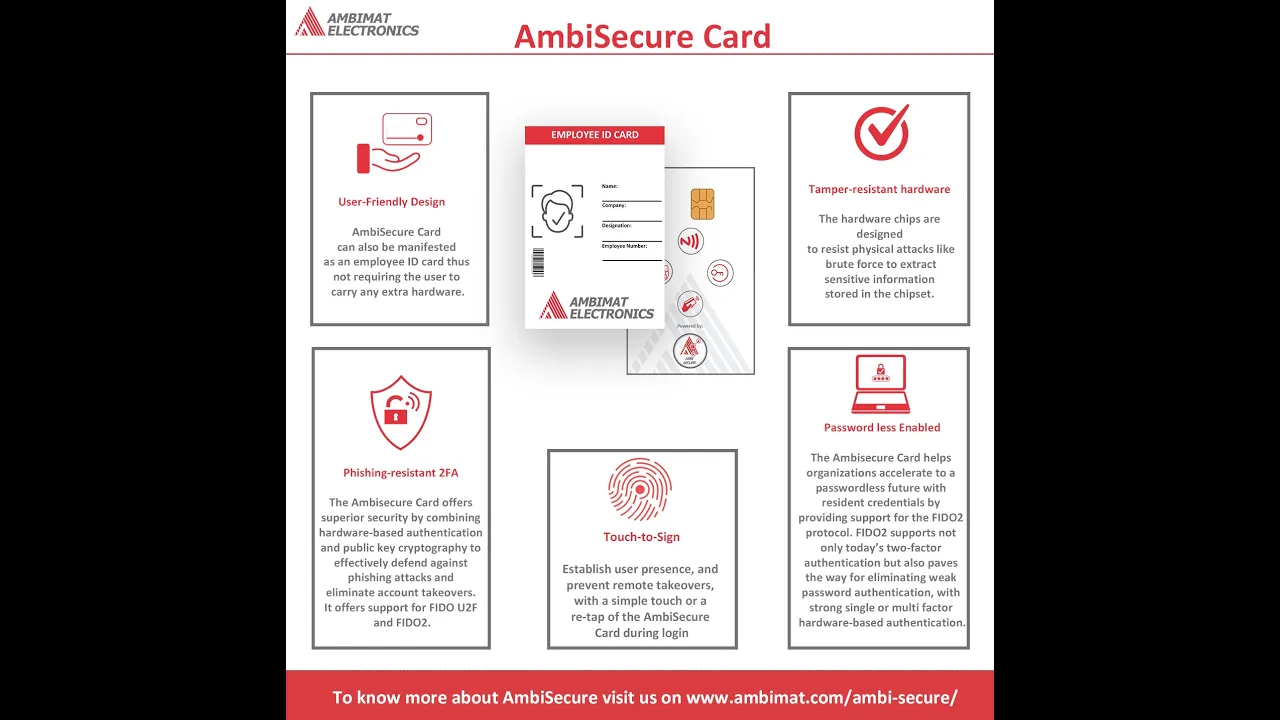
Hosted on YouTube. Open in YouTube →
Need a pilot, datasheet, or technical conversation?
Tell us the form factor, target deployment, and certification needs. Our engineering team will follow up directly.
Frequently asked questions
How can one card carry FIDO, PIV, door access, NDEF and OpenPGP at once?
Because JavaCard lets multiple applets share one chip with isolation between them. Each applet holds its own keys and is selected by its own AID, so the roles do not interfere.
Do the applets share key material?
No. Each applet has its own keys inside the secure element, and applet firewalling prevents one from reading another's data. That separation is what makes multi-application cards acceptable to security reviewers.
Can applets be added after a card is issued?
Yes, under the issuer's keys and over an authenticated secure channel. The card does not have to be replaced to gain a capability, which is a large part of the platform's value.
Does adding roles weaken any individual one?
Not cryptographically — the isolation holds. The practical constraints are memory and lifecycle: each applet consumes scarce storage, and every additional role is one more thing to manage at issuance and revocation.
Which interface does each role use?
FIDO and PIV work over USB or NFC, door access is typically contactless, and NDEF is read by any NFC phone. A dual-interface card serves all of them from one chip.