AmbiSecure IoT Security Chipset
Hardware secure-element integration for connected devices. Provisioning, attestation, signed key rotation, signed update — the foundation of an IoT root of trust.
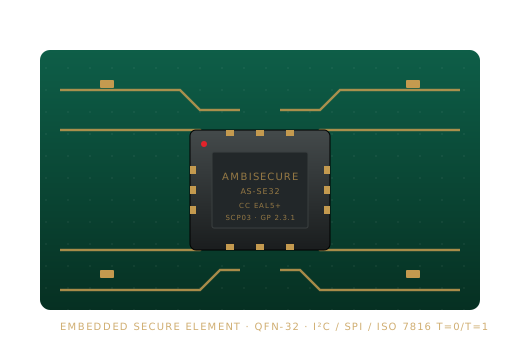
The device key has to outlive the device firmware.
Hardware root of trust
Device identity key generated and stored inside a tamper-resistant secure element. Never extractable. Never present in firmware.
Set/Get Master Key
Operations include Set/Get Master Key, key pair generation, data signing, and proprietary extensions for specific deployments.
Attestation
Each device proves its identity to the back end with a signed attestation derived from the SE root key.
Field key rotation
Operational keys can be rotated over the air without recalling the device, while the root remains unchanged.
Signed update
Firmware images are verified inside the SE before the host MCU executes them. Boot is gated on signature.
Volume-friendly
Small package, simple host interface (I²C or SPI), straightforward integration cost for high-volume IoT.
What ships in silicon.
| Form factor | QFN / SOIC packages; integration via I²C or SPI; ISO/IEC 7816-3 contact variant available |
|---|---|
| Cryptography | ECC P-256 / P-384, RSA 2048 / 3072, AES-128 / 256, SHA-256 / SHA-384, HMAC, ECDSA |
| Operations | Set/Get Master Key, Key Pair Generation, Sign Data, Verify, Encrypt/Decrypt, secure messaging |
| Provisioning | Per-device unique key injection at our personalisation line, or in-field over a secure channel |
| Tamper resistance | Active shield, voltage and clock monitors, fault-injection countermeasures |
| Operating range | Industrial -40°C to +85°C; extended automotive temperatures on request |
| Certification target | Common Criteria EAL5+ chip; SE-compliant integration patterns for AVA_VAN.5 |
| Sample SDK | Reference C driver for Linux / RTOS / bare-metal MCU; Python tooling for provisioning lines |
How the SE sits in the device.
The host MCU runs firmware. The SE holds the keys. The two talk over a simple bus and a strict command set.
Boot
Host MCU asks SE to verify firmware signature.
Identity
Device presents SE-signed attestation to backend.
Provision
Backend pushes operational keys; SE wraps them under its master key.
Operate
Host calls SE for sign / verify / encrypt operations.
Rotate
Operational keys rotate. Root never moves. Device stays in field.
Where this fits in the bigger picture.
Designing a connected device that needs a real root of trust?
We integrate the SE, write the host driver, and provision keys on our line so your factory does not have to.